
Coordinatorship of Corporate Communication
Coordinatorship of Corporate Communication
Coordinatorship of Corporate Communication Content
She survived thanks to a stent placed in his liver vein
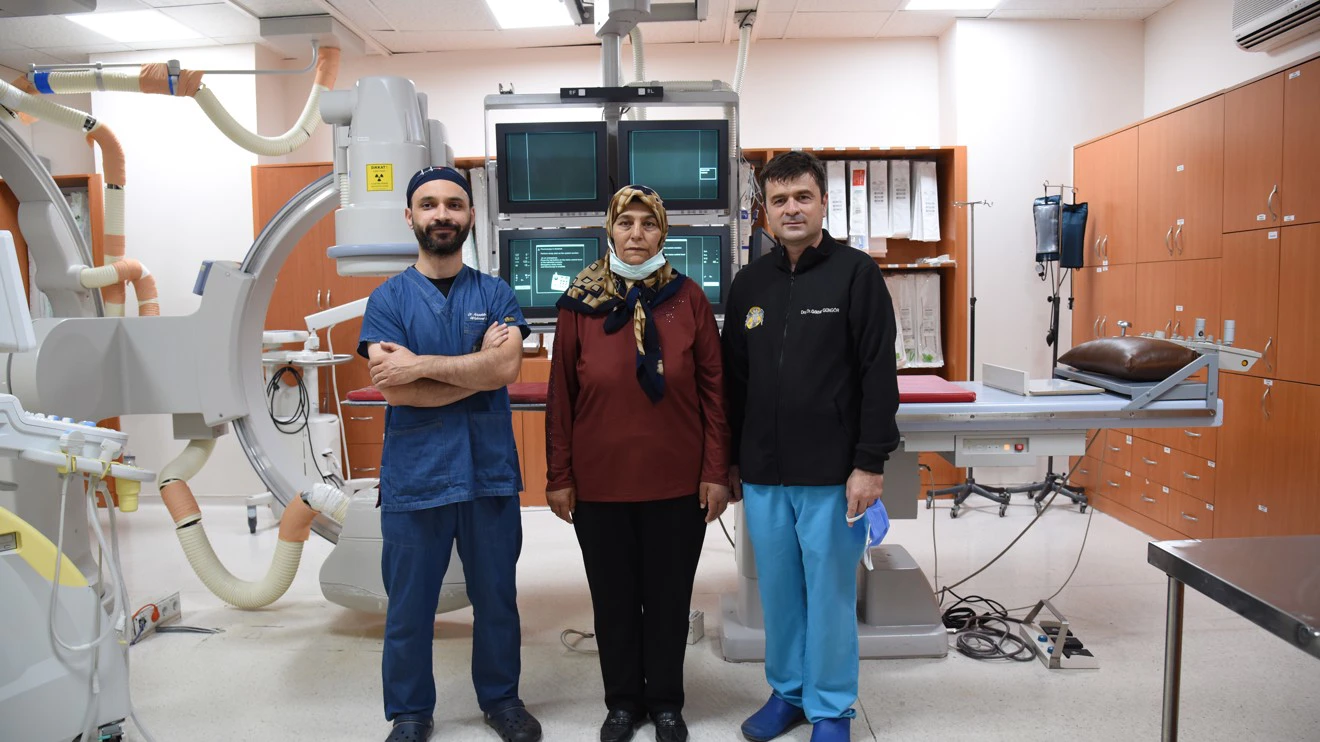
At Selçuk University medical faculty hospital, Fadimana Kök (56), who frequently suffered from life-threatening variceal bleeding due to portal hypertension due to liver cirrhosis and was therefore placed on the liver transplant list, was removed from the liver transplant waiting list thanks to the stent placed in the liver vein (portal vein).
Selçuk University Interventional Radiology Department Faculty Member Assoc. Prof. Dr. Alaaddin Nayman said that Fadimana Kök, who lives in Ilgın district of Konya, applied to the university hospital with the complaint of variceal bleeding and was diagnosed with cirrhosis as a result of the tests performed afterwards. Stating that the liver has an important function in filtering the blood coming from the intestines and delivering this filtered blood to the heart, Assoc. Prof. Dr. Nayman stated that in chronic liver diseases, the liver hardens due to the development of cirrhosis depending on the development of cirrhosis and as a result of the loss of its properties, the blood coming from the intestines starts to prevent the blood from going to the heart.
Stating that the increased pressure in the vein called portal vein due to the inability to transport blood from the intestines to the liver causes varicose veins to form on the intestinal walls, Assoc. Prof. Dr. Nayman said: "These varicose veins can cause bleeding over time due to high pressure and these bleeding can be life-threatening. In this way, our patient had portal hypertension on the background of cirrhotic liver. We performed Transjugular Intrahepatic Porto-systematic Shunt (TIPS) procedure to save the patient from portal hypertension and to prevent these variceal bleeding. TIPS procedure is the process of creating a shunt between the portal vein and the vein going to the heart by angiographic methods. After this shunt, the pressure in the portal vein decreases, the varicose veins deflate and we no longer see variceal bleeding as in our patient. Our patient's shunt has been working well for the last year. Our patient, who had to be hospitalized frequently before, has not had variceal bleeding in the last year. Her stent is open, she is doing well. We are also happy with this procedure we have done."
"WE DIDN'T HAVE MUCH TIME TO LOSE"
Gastroenterology and Hepatology Department Faculty Member Assoc. Prof. Dr. Gökhan Güngör noted that their patient, whom they followed up with the diagnosis of chronic liver disease, frequently suffered from life-threatening duodenal variceal bleeding due to portal hypertension despite having a good liver reserve, and that the patient was placed on the organ waiting list for liver transplantation after the bleeding recurred frequently.
Explaining that they usually detect variceal bleeding in the esophagus, and in this case, they atypically saw variceal development in the duodenum, Assoc. Prof. Dr. Güngör said, "Although we performed endoscopic, medical and even embolization treatments for our patient's varices, the frequency of bleeding and hospitalization was increasing, considering the limitation of organ donation in Türkiye, he may have to wait a long time, we did not have much time to lose. Together with our Interventional Radiology Unit, we decided to perform the TIPS procedure. TIPS procedure can be performed in very few centers in our country. When it is performed, problems such as blockages in the stent, displacement of the stent, infection can still develop. TIPS has been working effectively for about a year without any problems in our patient. As long as her liver reserve does not deteriorate, we can monitor her without transplantation for the time being. We thank our Interventional Radiology team for this successful procedure."
Fadimana Kök stated that she was hospitalized in intensive care for about a year due to variceal bleeding and said, "First of all, I would like to thank Gökhan, Hüseyin, Alaaddin and all health personnel. Thank God, I have become very good in a year. I got better thanks to the treatments of our professors."