Coordinatorship of Corporate Communication
Coordinatorship of Corporate Communication
Coordinatorship of Corporate Communication Content
Prof. Dr. Aksoy: We aim to be the pioneer of production
Selçuk University, which brings science together with agriculture, industry and commerce, has implemented many applications to transform scientific knowledge into added value and has become one of the leading institutions in university-industry cooperation, has taken another step to reduce the cost of farmers and increase their productivity.
The "Native Variety Development and Modern Breeding Training Greenhouse Project" prepared by the Faculty of Agriculture will be supported by the Konya Plain Project (KOP) Regional Development Administration.
With the " Native Variety Development and Modern Breeding Training Greenhouse Project" prepared by Selçuk University Faculty of Agriculture, it is aimed to strengthen the educational infrastructure with training and publication activities for the breeding of field crops and ensuring the effective and sustainable use of soil and water resources in crop production. The project also aims to establish Konya's first fully controlled breeding greenhouse within Selçuk University, to shorten the breeding process by creating suitable conditions for the development of new varieties without being affected by seasonal changes, to shorten the breeding process by providing more than one stage progress in a year, to increase the interest of students in plant breeding, to teach modern breeding practices, agricultural techniques and technologies, and to increase R&D activities in field crops. Within the scope of the project, 2 fully controlled permanent breeding greenhouses of 500 square meters (heater, cooler, lighting, irrigation equipment, control building, glass greenhouse) will be established, laboratory materials will be purchased and visibility activities will be carried out. In the greenhouses, breeding work will be carried out in 4 different species (wheat, beans, peas, chickpeas) and the generations will be completed (such as 3 generations in 2 years). The total budget of the project is one million 575 thousand TL and one million 260 thousand TL will be financed by KOP Administration and 315 thousand TL by the University.
"SELÇUK UNIVERSITY HAS ASSUMED THE ROLE OF LOCOMOTIVE"
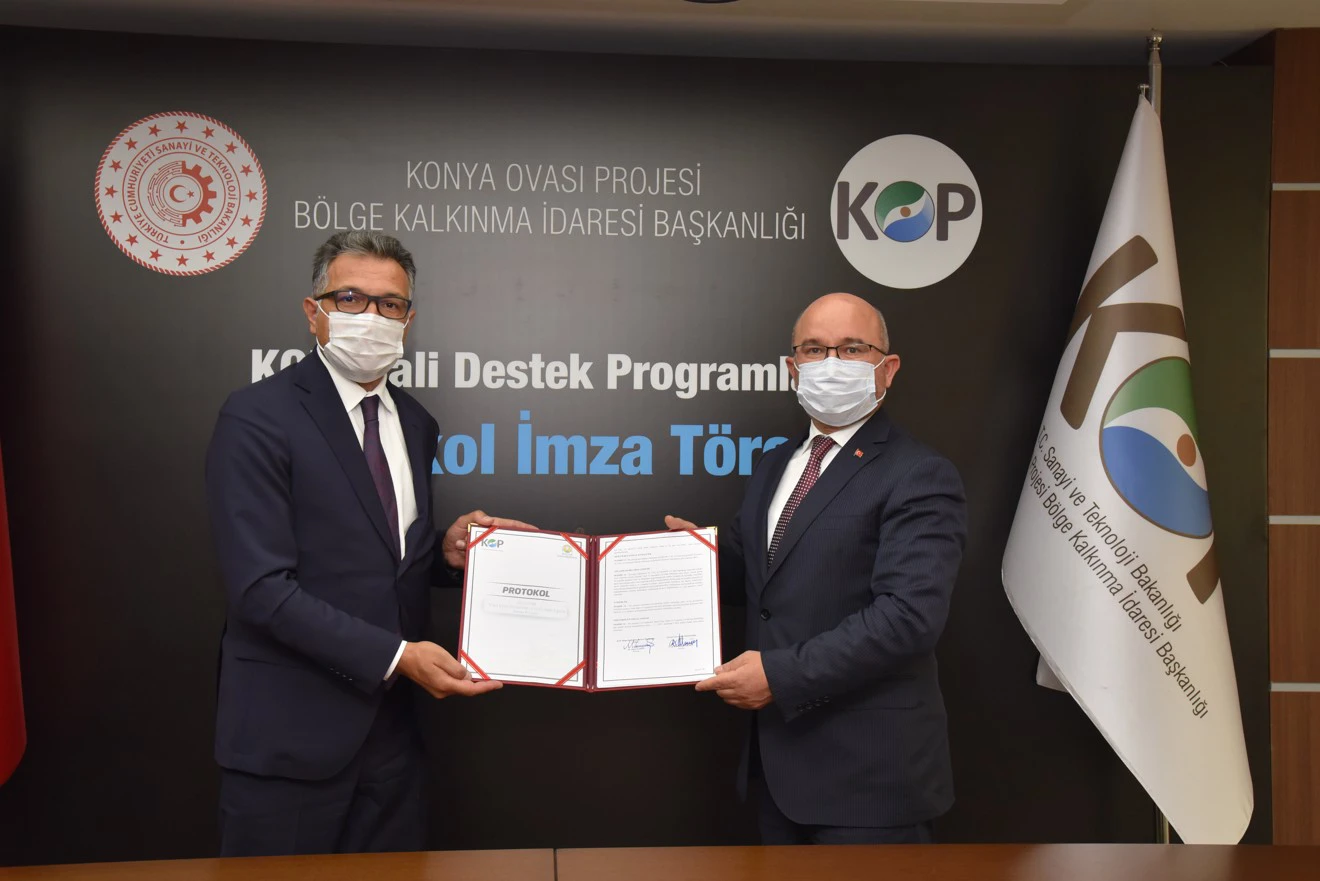
Rector of Selçuk University Prof. Dr. Metin Aksoy and Mahmut Sami Şahin, President of Konya Plain Project (KOP) Regional Development Administration, signed the protocol, which is of great importance for the agricultural sector.
Rector Prof. Dr. Aksoy stated that the Faculty of Agriculture has become one of the most important faculties in the region and has experience in such projects: "We have academicians who are consultants in the international arena. We are happy that our Faculty of Agriculture meets Konya, a city of agriculture and industry. This means the meeting of science and farmers, the meeting of science and farmers. We have implemented many projects such as ALO ZİRAAT - Farmer Hotline to solve the problems of farmers. It is very important for the development of Konya that two prominent institutions of the region, Selçuk University and KOP, act together. Selçuk University, which has raised the quality of education, has started to lead important projects in the region. It has assumed a locomotive role. We have gained the identity of a University that produces its own products and sells the patents it has prepared. We aim to be the pioneer of production in domestic and national issues. I wish the project to be auspicious.
“PROJECTS PREPARED BY SELÇUK UNIVERSITY ARE MEETING THE INDUSTRY”
Mahmut Sami Şahin, President of Konya Plain Project (KOP) Regional Development Administration, said: "Selçuk University, the oldest university of Konya, is the founding university of UNİKOP. We are very happy that the projects prepared by Selçuk University related to the agricultural studies of Konya, which is an agricultural city, meet with the sector. It is not possible to reach the desired point in agriculture without academic and scientific studies. While we support agricultural practices in the field, we will also support academic studies at the university and we will achieve a holistic structure in regional development. I wish the project to be beneficial."